Question: What was Kerouac's favorite book that he wrote?
Dave
Responds: Although Kerouac considered Visions of Cody to be his masterwork, a view now shared by most
Kerouac scholars, Allen Ginsberg, on first reading the book in 1952, declared it "a holy mess" and
stated that he did not think it could be published anywhere. Publishers apparently shared that view,
and although various short extracts appeared in magazines, the book remained unpublished until
January 1960, when Excerpts from Visions of Cody appeared in a limited, signed edition of 750
copies from New Directions. This version comprised about one third of the total text, and the book
was not published in full until January 1973, more than three years after Kerouac's death.
Kerouac wrote Visions of Cody between October 1951 and April 1952, in New York and San Francisco.
A 23-page section entitled "October in the Poolhall" was written in October 1950, six months before
the scroll version of On the Road, and incorporated into Visions of Cody in 1952.
Dave adds this information: Here are a few examples of Kerouac claiming that Visions of Cody was his greatest work. The third example closes with a quote from the book, which originally had the title Visions of Neal --
"Visions of Neal," is about the same guy who is the main character in "On the Road." It's the greatest I've done, but the world isn't ready for it, and it won't be published for twenty years."
[Interview with Jerome Beatty, September 1957]
Visions of Neal, my greatest book, right there. Visions of Neal. All in pencil.
[Interview with Al Aronowitz, March 1959]
My own best prose has yet to be published, my Visions and Dreams and Dharmas -- when I want a friend to enjoy my style I hand him these unpublished things but the editors have been reluctant to go all out and print these. ("Madroad driving men ahead, lonely, leading around the bend into the openings of space towards the horizon Wasatch snows promised us in the vision of the West, spine heights at the World's end, coast of blue Pacific starry night -- nobone halfbanana moons sloping in the tangled night sky, the torments of great formations in mist, the huddled invisible insect in the car racing onwards, illuminate.")
[The Last Word, June 1959]
Editor's Note: It seems that Kerouac's favorite book changed, depending on various factors. In a 1957 interview in the "Village Voice" with Jerry Tallmer, Kerouac states that Dr. Sax is his favorite. From the article:
[Kerouac says] "I've written eight books since 'On the Road.' Viking's going to start bringing them out."
"What's your best one?"
"A book called 'Dr. Sax,' a kind of Gothic fairy tale, a myth of puberty, about some kids in New England playing around in this empty place when a shadow suddenly comes out at them, a real shadow. A real shadow," he said, stressing the image, his black eyes flashing."
Question - What books make up the Duluoz legend? And what years do they cover?
Answer: Kerouac's explanation of the Duluoz legend.
"My work comprises one vast book like Proust's Remembrance of Things Past except that my remembrances are written on the run instead of afterwards in a sick bed. Because of the objections of my early publishers I was not allowed to use the same personae names in each work. On The Road, The Subterraneans, The Dharma Bums, Doctor Sax, Maggie Cassidy, Tristessa, Desolation Angels, and the others are just chapters in the whole work which I call The Duluoz Legend. In my old age I intend to collect all my work and reinsert my pantheon of uniform names, leave the long shelf full of books there, and die happy. The whole thing forms one enormous comedy, seen through the eyes of poor Ti Jean (me), otherwise known as Jack Duluoz, the world of raging action and folly and also of gentle sweetness seen through the keyhole of his eye". [BIg Sur, preface]
The novels included in The Duluoz Legend include the following, in the order of time covered:
BOOK TITLE |
TIME COVERED |
WRITTEN |
PUBLISHED |
Atop an Underwood |
Various |
1936–1943 |
1999 |
Visions of Gerard |
1922–1926 |
1956 |
1963 |
Doctor Sax |
1930–1936 |
1952 |
1959 |
The Town and the City |
1935–1946 |
1946–1949 |
1950 |
Maggie Cassidy |
1938–1939 |
1953 |
1959 |
Vanity of Duluoz |
1935–1946 |
1968 |
1968 |
On The Road |
1946–1950 |
1948–1956 |
1957 |
Visions of Cody |
1946–1952 |
1951–1952 |
1959 & 1973 |
The Subterraneans |
1953 |
1953 |
1958 |
Tristessa |
1955–1956 |
1955–1956 |
1960 |
The Dharma Bums |
1955–1956 |
1957 |
1958 |
Desolation Angels |
1956–1961 |
1956–1957 |
1965 |
Big Sur |
1960 |
1961 |
1962 |
Satori in Paris |
1965 |
1965 |
1966 |
Note: There are two books that are sometimes included in the Legend of Duluoz, and sometimes not.
- Lonesome Traveler – This is not a novel, but is a collection of essays and sketches
- Book of Dreams – This is also not a novel, but a dream-journal from dreams recorded between 1952 and 1960
Kerouac Books in the order they were published:
The Town and the City [1950]
On the Road [1957]
The Subterraneans [1958]
The Dharma Bums [1958]
Doctor Sax [1959]
Mexico City Blues: 242 Choruses [1959]
Maggie Cassidy [1959]
Tristessa [1960]
Lonesome Traveler [1960]
The Scripture of the Golden Eternity [1960]
Book of Dreams [1961]
Pull My Daisy [1961]
Big Sur [1962]
Visions of Gerard [1963]
Desolation Angels [1965]
Satori in Paris [1966] .
Vanity of Duluoz: An Adventurous Education, 1935-46 [1968]
Pic: A Novel [1971]
Scattered Poems [1971]
Visions of Cody [1973]
Trip Trap - Haiku (with Albert Saijo & Lew Welch) [1973]
Heaven and Other Poems [1977]
Pomes All Sizes [1992]
Old Angel Midnight [1993]
Good Blonde & Others [1993]
Selected Letters, Vol 1 [1995]
San Francisco Blues [1995]
Book of Blues [1995]
Some of the Dharma [1997]
Atop an Underwood [1999]
Jack Kerouac: Selected Letters, Vol 2, 1957-1969 [2000]
Book of Dreams, first unabridged edition [2001]
Orpheus Emerged [2002]
Book of Haikus [2003]
The Beat Generation (a play) [2005]
Book of Sketches [2006]
Wake Up: A Life of the Buddha [2008]
And The Hippos Were Boiled in their Tanks (with William Burroughs) [2008]
The Sea is My Brother [2012]
Back To Top
Question - I'm living on the short Russell
St alley in San Francisco -- adjacent to where Neal Cassady lived for
a number of years and Jack stayed for some time. Do you happen to
know when Jack was staying here? Was he writing anything while
staying with the Cassady's?
Dave responds: Kerouac visited the Cassadys several times after they had moved into 29
Russell Street in 1949. His longest stay was from December 1951 until April
1952. During that period he worked mainly on "Visions of Cody." One of the
sections of this book is "Joan Rawshanks in the Fog," an account of Joan
Crawford filming a scene on Hyde Street for the noir movie "Sudden Fear,"
which Kerouac witnessed on one of his evening rambles around Russian Hill.
The "white San Francisco apartment house" where Kerouac describes the action
taking place was the eleven-story Tamalpais Apartments, still standing at
1201 Greenwich Street at Hyde.
Question
- What book is Jack Kerouac reading from when he was on the
Steve Allen Television show? Is it only On The Road (which he
seemed to be reading from)?
Dave
Responds: In the
Steve Allen TV Show of November 1959, Kerouac begins reading two
sections from Visions of Cody.
"At the junction of the state line of
Colorado ..." (p.295)
"I'm writing this book because we're
all going to die ..." (p.368)
and finishes with the final paragraphs of
On the Road:
"Dean, ragged in a motheaten overcoat
..."
He does appear to be reading from the
front of his copy of On the Road. I guess he'd typed
out those three sections especially for that reading, and
had them taped into the front of his book.
Back To Top
Question -
I've been looking all over for Kerouac's "Wake-Up".
Where would I be able to get a copy of the book? Also, did
"The Buddhist Bible" influence Jack Kerouac's inclinations towards
Zen?
Dave Responds: "Wake Up" was finally published in 2008.
Selections from it previously appeared in the magazine
"Tricycle: The Buddhist Review", in eight parts, between
1993 and 1995.
Kerouac wrote a letter
to Allen Ginsberg in May 1954 citing the books that
he had found useful in his study of Buddhism. The letter is
published in "Jack Kerouac: Selected Letters, 1940-1956," page
415. He writes that "The Buddhist Bible" by Dwight Goddard was
"by far the best book" on the subject. The book is still easily
available from any good bookshop, or used copies for between $6
and $10 from dealers listed on-line.
Question: What
writers and books most influenced Jack Kerouac? I am aware of Saroyan,
Wolfe, Whitman, but that’s about it.
Dave
Responds:
I don’t know of any books that go into detail about Kerouac’s
literary influences, although most of the biographies mention some.
As
always, I think it best to go back to primary sources like Jack’s
own writings, for answers. In his biographical notes for The New
American Poetry (reprinted in Good Blonde) he tells us
that he began “serious writing” after he “read about Jack London at
the age of 17.” Kerouac went on to read many of London’s books
including his travel diaries The Road, which inspired
Kerouac’s own On the Road. He then mentions that he read
Ernest Hemingway and William Saroyan at 18, and “began writing
little terse short stories in that general style.” This was
followed, while a Columbia freshman, by reading Thomas Wolfe which
inspired him to write “in the rolling style.” Kerouac’s first
published novel, The Town and the City was very much
influenced by Wolfe’s Look Homeward, Angel. While at
Columbia, Kerouac studied Shakespeare with Professor Mark Van Doren.
According to Jack, he then began reading James Joyce, and “wrote a
whole juvenile novel like Ulysses called Vanity of Duluoz”
(the 1942 version, unpublished apart from excerpts in Atop an
Underwood). Then came Dostoevsky, a romantic phase with Rimbaud
and William Blake, and, at 24, Goethe’s Dichtung und Wahrheit.
Other writers known to have had a major effect on Kerouac were
Oswald Spengler, for his work Decline of the West, introduced
to him by William Burroughs, and Louis-Ferdinand Céline, primarily
for Journey to the End of the Night. In Vanity of Duluoz
(the later, 1968 version), Jack states that Allen Ginsberg was
responsible for introducing him to Yeats, Huxley, Nietzsche,
Lautréamont, and others. At the same time Jack was reading Thomas
Mann, Herman Melville, Sigmund Freud, and H.G. Wells.
Kerouac also cites as influence “the marvellous free narrative
letters of Neal Cassady,” especially the ones that he received in
1950, which led him to discover “a style of my own based on
spontaneous get-with-it” that he used in his 1951 scroll version of
On the Road. He wrote that he also “learned a lot about
unrepressed wordslinging from young Allen Ginsberg and William
Seward Burroughs.”
Kerouac stated that the “confessional madness” style of his novel
The Subterraneans was based on that of Dostoevsky’s Notes
from the Underground, and that Visions of Gerard was
directly influenced by Shakespeare’s Henry V, “the language
is so windblown and Shakespearean.” He also claimed that his later
experimental prose piece Old Angel Midnight was inspired by
James Joyce’s Finnegans Wake, “scribbled out in a strictly
intuitional discipline at breakneck speed.”
Back To Top
Question - Was
Bob Dylan influenced by
Jack Kerouac?
Dave responds: Dylan has recently been
more forthcoming about his early influences. In both his
autobiography, Chronicles, and the documentary film No
Direction Home, he talks about the effect that reading Kerouac
had on him.
He says that On the Road
“had been like a bible for me. I loved the breathless, dynamic bop
poetry phrases that flowed from Jack’s pen . . . I fell into that
atmosphere of everything Kerouac was saying about the world being
completely mad, and the only people for him that were interesting
were the mad people, the mad ones, the ones who were mad to live,
mad to talk, mad to be saved, desirous of everything at the same
time, the ones who never yawn, all of those mad ones, and I felt
like I fit right into that bunch.”
But Dylan adds: “One guy gave
me a book that Woody Guthrie wrote called Bound For Glory,
and I read it. I identified with that book more than I even did with
On the Road.”
 When
Allen Ginsberg was travelling with Dylan during the Rolling Thunder
Review tour of 1975 they visited Lowell, Massachusetts and stopped
by Kerouac’s gravestone at Edson Cemetery, where, in a scene which
appeared in the movie Renaldo and Clara, they read choruses from
Kerouac’s Mexico City Blues. Ginsberg asked Dylan how he knew
Kerouac’s poetry and Dylan replied: “Someone handed me Mexico
City Blues in St. Paul [Minnesota] in 1959 and it blew my mind.
It was the first poetry that spoke my own language.” Dylan mentions
Mexico City Blues in his song Something’s Burning, Baby
from the 1985 album Empire Burlesque. When
Allen Ginsberg was travelling with Dylan during the Rolling Thunder
Review tour of 1975 they visited Lowell, Massachusetts and stopped
by Kerouac’s gravestone at Edson Cemetery, where, in a scene which
appeared in the movie Renaldo and Clara, they read choruses from
Kerouac’s Mexico City Blues. Ginsberg asked Dylan how he knew
Kerouac’s poetry and Dylan replied: “Someone handed me Mexico
City Blues in St. Paul [Minnesota] in 1959 and it blew my mind.
It was the first poetry that spoke my own language.” Dylan mentions
Mexico City Blues in his song Something’s Burning, Baby
from the 1985 album Empire Burlesque.
Kerouac’s influence can also
be heard on Dylan’s earlier album, Highway 61 Revisited. Two
of the songs, Desolation Row and Just Like Tom Thumb’s
Blues include direct quotes from Kerouac’s novel Desolation
Angels, including the phrases "the
perfect image of a priest," "her sin is her lifelessness," and
"Housing Project Hill." It is also informative to compare the song
title Desolation Row and the phrase "junkyard angel" (used
in another of the songs on the album -- From A Buick 6)
with the title of Kerouac's book.
Desolation Angels
was published in May 1965, and Highway 61 Revisited
recorded in August 1965. The book was the first major Kerouac work
to appear after Dylan began writing songs in the early 1960s.
Clearly, Dylan was sufficiently affected by Kerouac's book that he
chose to write those phrases into his new songs.
Back To Top
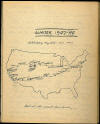 Question: Is there a map of Kerouac's trips cross country? Question: Is there a map of Kerouac's trips cross country?
Dave
responds:
Concerning a map of Jack's OTR
travels, there is one of the 1947-48 journey in the Kerouac ROMnibus.
I'm attaching a copy of it here. I hope that helps. (click on
picture to enlarge)
Question: I'm trying to
figure out if Jack Kerouac used Highway 190
or Highway 90 when he passed through Southwest/SouthCentral
Louisiana on his famous On the Road trip with Neal.
I'm from a
small town called Basile. It amazes me that one night in 1949 Jack
Kerouac's infamous roadtrip might have passed through my podunk
village. My dad was a high school junior then, so I have this idea of
a story somehow linking his life to that historic journey in a
fictional account. Wish me luck. Any info would be appreciated.
Dave Responds:
In On the Road, Part Two,
Chapter 8, Kerouac describes his journey through Louisiana with Neal
and LuAnne in January 1949, after leaving William Burroughs' house
in Algiers, New Orleans.
They travelled to Baton Rouge, and then on to Port Allen, and
through Opelousas, Lawtell, Eunice, Kinder, De Quincy, Starks, and
Deweyville, entering Texas at Beaumont. These places are all on
Highway 190, the northern of the two routes. Basile is between
Eunice and Elton, and Jack and friends would undoubtedly have passed
through there some time
around the last week of January 1949. Good luck with your story!
Back To Top
Question: I know that
the events described in Kerouac’s novel The Subterraneans
actually took place in New York (rather
that San Francisco as portrayed in the book).
However, I’d be interested to know whether the bar names used -- the
Red Drum, the Black Mask, and Dante’s -- were actual places or just
names that Jack made up.
Dave Responds:
They are all names invented by Kerouac. In
his reading of a passage from The Subterraneans on his Verve
album he actually mentions the real name of one place -- the Open
Door -- in parentheses after the Red Drum.
We know that the events described in The Subterraneans took
place in the summer of 1953. Charlie Parker had been playing the
Open Door, in New York's Greenwich Village, close to Washington
Square, on occasional Sunday nights since its opening that April.
It seems that Jack saw him there sometime in August, as described in
the book. Of the other bars mentioned -- the Black Mask was really
the San Remo, and Dante's was Fugazzi's -- both in the Village. You
can read more about all of these places in Bill Morgan’s useful
book, The Beat Generation in New York: A Walking Tour of Jack
Kerouac’s City.
Back To Top
Question: I am
interested in Mardou Fox (really Alene Lee)
of Kerouac's novel The Subterraneans. Can
you tell me more about her, and possibly indicate where I might find a
photo of her?
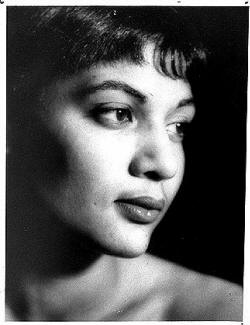 Dave Responds:
Despite the fact that she was
undoubtedly one of Kerouac’s main inspirations, there's little to be
found about Alene Lee anywhere, and surprisingly, perhaps, nothing
at all in those books devoted to the female muses and writers:
Women of the Beat Generation, A Different Beat, and
Girls Who Wore Black. Dave Responds:
Despite the fact that she was
undoubtedly one of Kerouac’s main inspirations, there's little to be
found about Alene Lee anywhere, and surprisingly, perhaps, nothing
at all in those books devoted to the female muses and writers:
Women of the Beat Generation, A Different Beat, and
Girls Who Wore Black.
Alene Lee
was an attractive, intelligent black woman, half-Cherokee. Kerouac
met her in the late summer of 1953 when she was typing up the
manuscripts of William Burroughs and Allen Ginsberg, who at that
time were sharing an apartment in New York’s Lower East Side.
Bill Morgan's The Beat Generation in New York has a small
section on Alene, and a photo of her with William Burroughs in 1953,
the time of her romance with Kerouac (p.125).
There's a different photo of Alene with Burroughs from the same time
in the anthology The Beat Journey (p.172), and this is
reprinted in The Beat Vision (p.208).
The Kerouac ROMnibus contains an excellent photograph of Alene, and
Steven Turner's Angelheaded Hipster (p.142) shows Kerouac
holding that photo.
On the same page of Turner's book there’s a photograph of Alene with
Kerouac from 1953, and this can also be found in David Sandison's
biography of Jack Kerouac (p.106).
According to Aram Saroyan's autobiographical work, The Street,
in the 1960s Alene was living with Kerouac's old friend Lucien Carr
in New York.
Alene
also appears as Irene [May] in Kerouac’s other works, Book of
Dreams, and Big Sur.
Back To Top
Question: I’ve read
that, at the famous Six Gallery poetry
event in San Francisco, on Friday, October 7, 1955, where Allen
Ginsberg first performed Howl, Philip Lamantia was present but
did not read his own poetry. Instead he apparently read the poems of
his friend, John Hoffman, who had recently died in Mexico. What about
Hoffman and his poetry – do you know anything about him?
Dave Responds:
John Hoffman was the poet friend of Philip Lamantia and Gerd Stern.
He had died, aged 21, in Mexico from either peyote poisoning or
polio. The symptoms, according to William Burroughs, were identical.
Hoffman, although unpublished, had become an underground legend by
the mid-1950s, and his surviving twenty-nine short poems, collected
under the title Journey to the End, were similar to
Lamantia's in their surrealism. Lamantia read a selection of
Hoffman's poems, rather than his own, at the Six Gallery event.
Little has been written about Hoffman, although Gerd Stern describes
their times together in his book, An Oral History. He writes
about meeting John Hoffman at the San Remo bar in New York and
taking a sea voyage on a Norwegian ship to Rio de Janeiro around
1950 during which they were both "writing poetry like mad." He says
that "[John] was found on the beach at Zihuatanejo in Mexico dead.
What probably happened is he had an overdose and lay down to sleep
in the sun, and the drug and the sun killed him."
Carl Solomon (dedicatee of Howl) also knew Hoffman,
and writes about him in his book Emergency Messages (p.70):
“John was a spaced-out type who called everyone ‘Man’ as did Gerd.
When the captain of the ship asked John to bring him soup , John
misunderstood and brought the captain a bar of soap.”
Hoffman
appears in a couple of Kerouac’s books. He's "John Parkman" in
Visions of Cody and "Altman" in The Dharma Bums -- but
both appearances are very brief.
From
Visions of Cody (1952): "That's what John Parkman did, committed
suicide on Peyotl, the new sleeping pill." (p.333) and in The
Dharma Bums, "Delicate Francis DePavia [Lamantia] read, from
delicate onionskin yellow pages, or pink, ... the poems of his dead
chum Altman who'd eaten too much peyote in Chihuahua (or died of
polio, one) but read none of his own poems." (p.15)
Hoffman also appears in William Burroughs's Junkie
as "one of those junkies" in Mexico City (towards the end of the
book). In Poets on the Peaks, John Suiter says that "Almost
nothing is known now, or was even then [1955], about John Hoffman"
(p.150) and claims that "he was also a minor character in Kerouac's
The Subterraneans." I’ve not been able to substantiate that
claim. Does anyone have any suggestions? (Hoffman would have been
dead for a couple of years before the events Kerouac writes about in
The Subterraneans, 1953.)
A limited edition of 24 copies of Hoffman's Journey to the End
collection was published by Kolourmein Press of "Oaktown,"
California in November 2000. (Suiter, p.304)
Back To Top
Question: I have been
wondering for some time whether the film script
that Kerouac mentions in chapter 11 of book one of On the Road
has survived; the "gloomy tale about New York" that Sal [Jack] writes
in Mill City, which Remi Boncoeur [Henri Cru] has asked him to do and
which Remi takes along to Hollywood to show to a film director. Do you
know more about it?
Dave responds:
I once asked Henri Cru about this. He told me that the "famous
director and an intimate of W.C. Fields" was Gregory La Cava
(1892-1952), father of Henri's friend William Morse La Cava.
According to the IMDB: "La Cava is also supposed to have directed
some scenes in several of the films of his close friend W.C. Fields
when Fields couldn't get along with the directors assigned to him,
although there is no official record of this ever happening." Henri
didn't know what had happened to the film script that Kerouac wrote.
Back To Top
Question:
I’ve always liked Kerouac’s description, under the title of “Joan
Rawshanks in the Fog”
in Visions of Cody, of watching Joan Crawford making a movie in
San Francisco. Can you tell me more about the movie being made, and
when it happened?
Dave responds:
The occasion was early 1952, when Jack was staying with Neal and
Carolyn Cassady at their home in Russell Street, on San Francisco’s
Russian Hill. Jack witnessed the filming while he was out walking
one evening, and he went back home and wrote about it. As you
correctly say, his account eventually appeared as the "Joan
Rawshanks in the Fog" section of Visions of Cody. In it
Kerouac writes that the location was on Hyde Street, and Carolyn
Cassady, in her autobiography Off the Road claims that it was
"only a block away" (from Russell Street). The book San Francisco
Noir: The City in Film Noir from 1940 to the Present by
Nathaniel Rich, examines forty or more noir movies and reveals the
locations in San Francisco where they were shot. The film in
question here was Sudden Fear, from a book by Edna Sherry, an
exciting noir drama (now available on DVD) starring Jack Palance and
Gloria Graham, as well as Crawford. The "white San Francisco
apartment house" where Kerouac describes the action taking place was
the eleven-story Tamalpais Apartments at 1201 Greenwich Street at
Hyde. The same building had been featured in another noir movie --
Dark Passage (1947) starring Humphrey Bogart and Lauren
Bacall and based on the novel by David Goodis. In that movie one of
the female characters falls to her death from a window in the
building.
Coincidentally, the home of the Joan Crawford character in Sudden
Fear was the mansion at 2800 Scott Street, which was also the
address of San Francisco Chronicle columnist Herb Caen, who,
some five years after the making of the movie was to coin the
infamous word "beatnik."
Back To Top
Question:
In the
story "The Great Western
Bus Ride" (in
the
March 1970 issue of Esquire),
Kerouac describes a solo bus trip from San Francisco to New York. It's
winter, and he writes as if he were visiting Montana for the first
time. The M&M bar
in Butte,
Montana, he says, "is
the end of my quest for an ideal bar."
Do you know when he wrote this article, and if it is part of some
other work? I checked Lonesome Traveler (not there) and have
been searching my dim memory for other mentions of Montana but can
only come up with Montana Slim from On the Road.
Dave Responds-
I’m not certain when Kerouac wrote
"The Great Western Bus Ride." The piece describes events that happened
in February 1949 when Jack was returning from San Francisco to New
York. It is known that Kerouac included this journey at the end of
Part 2 of his original scroll version of On the Road in April
1951, but was persuaded to remove it before publication of the novel
by his editor, Malcolm Cowley, in order to tighten up the action. It
is possible that “The Great Western Bus Ride” was either the original
piece of writing or else a reworking of it. Kerouac
evidently based his description of the trip on a journal account he
kept while traveling. This latter has recently been published in
Windblown World: The Journals of Jack Kerouac (pages 296-313)
where you can compare it with "The Great Western Bus Ride."
Kerouac mentions Montana in many of his novels (Visions of Cody,
Desolation Angels, Vanity of Duluoz), and also in his poetry (Mexico
City Blues, Book of Blues).
His bus ride through the state in 1949 must have made a big impression
on him.
|

